Here’s a decorating secret that professional stylists use in virtually every single room they design: when in doubt, put it on a tray. A tray is one of those deceptively simple tools that simultaneously organizes what you own, defines a visual boundary on any surface, and makes a random collection of objects look like a curated, intentional vignette.
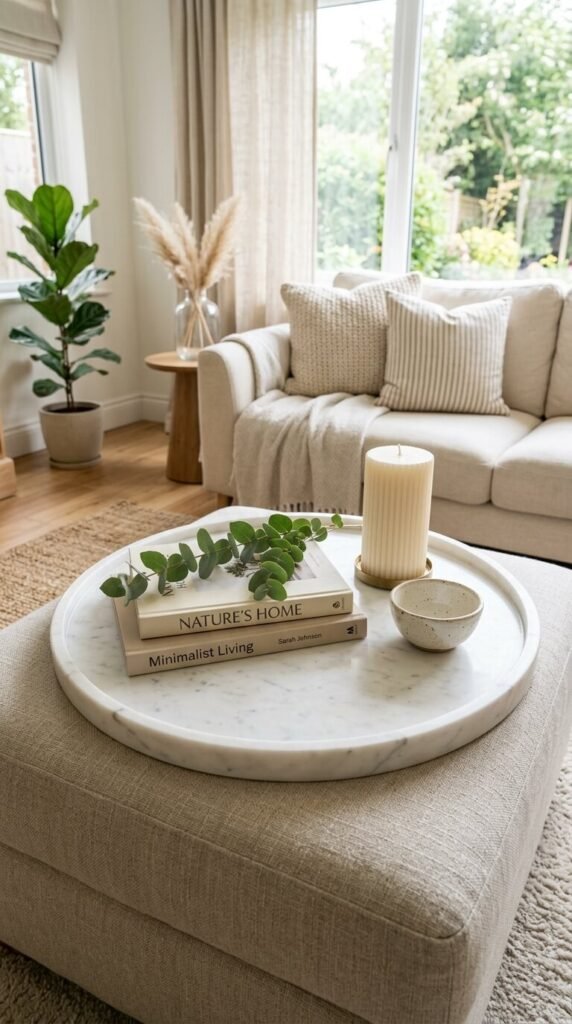
The best part? You don’t need new things to make it work. The candles, remotes, books, and small objects already scattered across your surfaces are the raw material. All you need is a tray and a little intention. Here’s exactly how to style one beautifully.
Choose the Right Tray for the Right Surface
Not all trays work on all surfaces — and choosing the right one for each location makes the difference between a vignette that looks purposeful and one that looks like an afterthought.
Match your tray to its surface with these guidelines:
- Coffee table — go large and low; a wide rectangular or round tray in wood, marble, or lacquer anchors the center of the table without blocking sightlines across the room
- Ottoman — a sturdy tray with raised edges works best here since ottomans move; look for something with enough weight to stay stable when someone sits nearby
- Console or entryway table — a longer rectangular tray corrals keys, mail, and everyday essentials without letting them spread across the whole surface
- Bathroom counter — small round or oval trays in ceramic, acrylic, or brass keep toiletries contained and instantly elevate the space
- Kitchen counter — a deep-sided tray near the stove or coffee station corrals cooking oils, spices, or coffee supplies into one organized, attractive zone
- Nightstand — a small tray keeps your nighttime essentials — lip balm, a book, your phone — from sliding all over the surface
Material matters too. Wood and rattan feel warm and organic; marble and stone feel elegant and substantial; brass and gold metal feel glamorous; lacquered trays feel crisp and modern. Match your tray material to the overall mood of the room.
Follow the Tray Styling Formula
Here’s the simple formula that makes any tray look intentional: one tall element, one medium element, one small element, and one natural or organic touch.
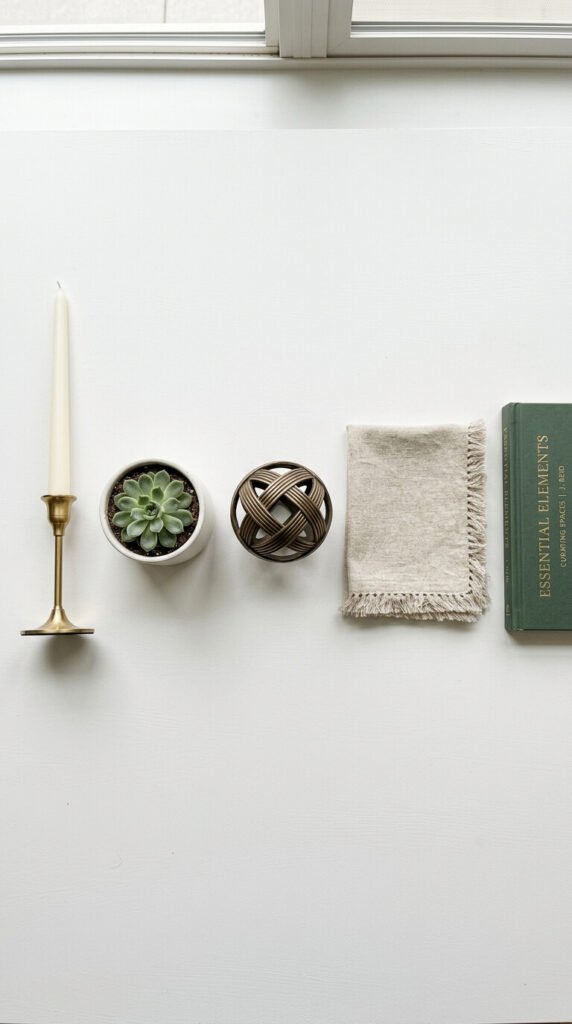
Breaking it down:
- Tall element — a candle, small vase with a single stem, or a slender sculptural object creates vertical interest and stops the tray from looking flat
- Medium element — a small stack of books, a bowl, a lantern, or a decorative box provides visual weight in the middle ground
- Small element — a small figurine, a single stone, a perfume bottle, or a decorative object adds detail and personality at the lowest level
- Natural touch — a sprig of eucalyptus, a small succulent, a few dried flowers, or even a pinecone adds life, organic texture, and softness that manufactured objects alone can’t achieve
You don’t need all four in every tray — sometimes two or three elements look more elegant than a fully loaded arrangement. The goal is variation in height and texture, not maximum quantity.
The Golden Rules of Tray Styling
Beyond the formula, a few guiding principles separate a beautifully styled tray from one that looks cluttered or staged.
Rule 1: Leave breathing room. Your tray should never look completely full. Negative space — the empty areas within and around your objects — is what gives the eye somewhere to rest and makes the styled objects feel deliberate rather than dumped.
Rule 2: Stick to a limited color palette. Two to three colors within a tray keep it looking cohesive. A white candle, a brass holder, and a green sprig work together. A red candle, a blue bowl, a yellow book, and a pink flower fight each other.
Rule 3: Odd numbers feel more natural. Three objects almost always look more balanced than two or four. Five works too. Even numbers tend to feel rigid and symmetrical in a way that reads as forced rather than organic.
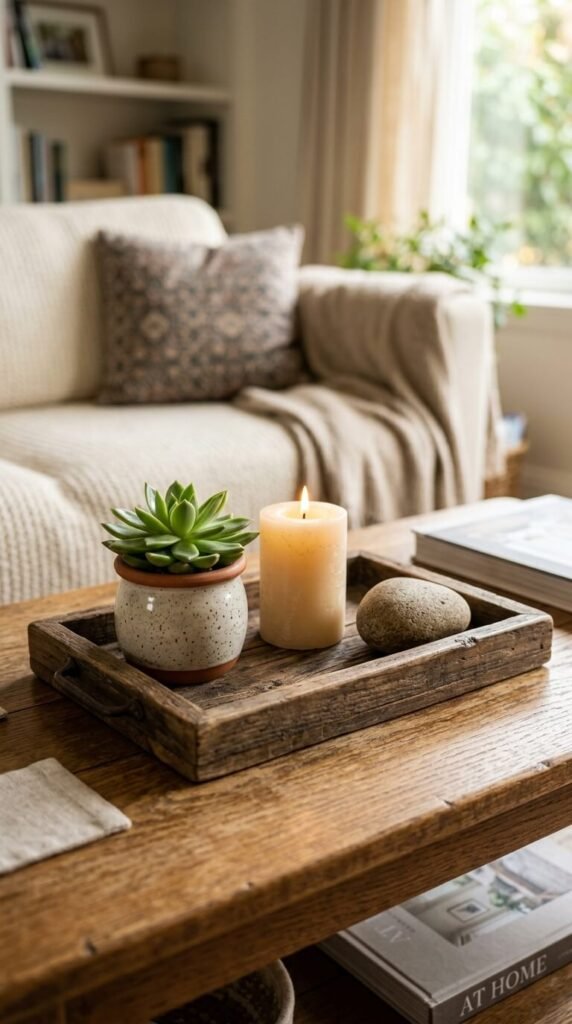
Rule 4: Mix textures, not just colors. A tray styled entirely in smooth objects feels flat. Combine something rough (a woven coaster, a natural stone), something smooth (a ceramic bowl, a glass vessel), and something soft (a small linen napkin, a sprig of greenery) for a tray that looks rich and layered.
Seasonal Swapping — One Tray, Four Looks
One of the most underrated things about tray styling is how easily it updates with the seasons. Your tray stays. Only the objects inside it change.
- Spring — fresh or faux florals, a pastel candle, a small bird figurine, a sprig of blossoms
- Summer — a shell or two, a citrus fruit in a small bowl, a light linen napkin, a bright green plant
- Fall — a mini pumpkin or gourd, a cinnamon or amber candle, a few acorns, a dried wheat stem
- Winter and holiday — a small pine sprig, a mercury glass ornament, a metallic candle, a cinnamon stick bundle tied with twine
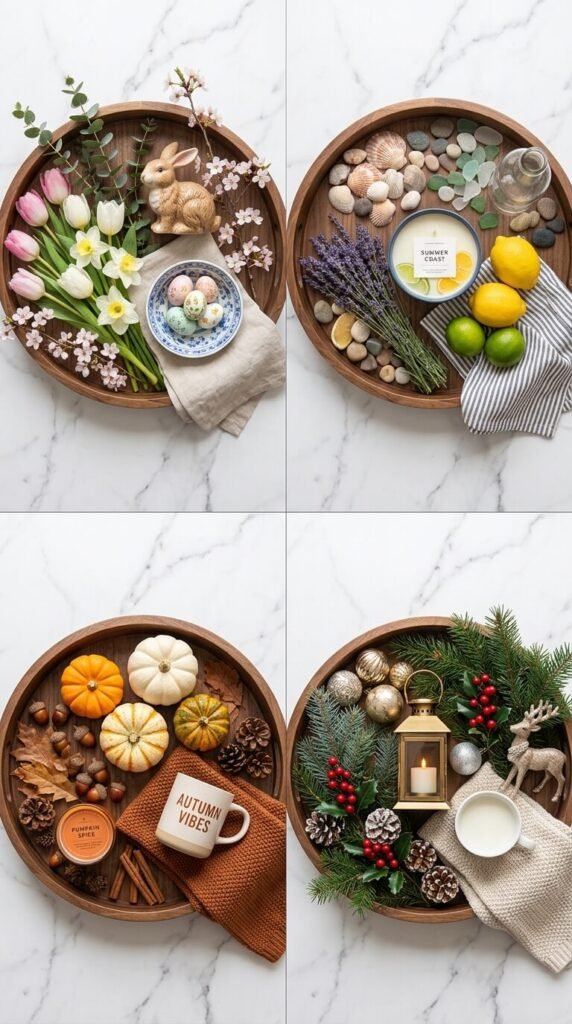
Each seasonal refresh takes under five minutes and costs virtually nothing if you rotate objects you already own throughout the year.
A beautifully styled tray is proof that organization and beauty don’t have to be separate goals — the best interiors achieve both at once. Contain what you have, style it with intention, and watch any surface in your home transform completely. Save this guide, grab a tray you already own, and style it today — it takes ten minutes and makes a bigger difference than you’d expect.